
Athlete Approved is reader supported. If you make a purchase through our links, we earn an affiliate commission, at no extra cost to you. We highly recommend all products and only promote items that are Athlete Approved.
Open water swimming is an amazing way to exercise. It allows you to experience nature, breathe in fresh non-chlorinated water, and is a great supplemental workout to pool swimming.
While there are many benefits of lap swimming, staring at the black line at the bottom of the pool can get boring. It is bad when you start having conversations with that black line. And it is even worse when the black line starts talking back to you!
The thought of swimming open water with no wall or bottom to rest on can be daunting. Here are 5 Athlete Approved tips that will help you be more confident swimming in open water:
- Learn how to sight
- Bring the right equipment
- Learn how to adapt to cold water
- Put open water safety first
- Use tides to your advantage
Learn How to Sight
The fastest route from point A to point B is a straight line. However, swimming straight when you are in open water swimming can be challenging.
It is easy to lose your direction in open water swimming. Keeping your sights on a stationary object is key.
Look up by slightly lifting your chin. While you do that, press down with your arm that is extended. If you arch your back, you will lose your forward momentum (#NotAthleteApproved).
After you look up, follow that up with a quick side breath.
Athlete Approved Tip: Sight less in open water! Beginners tend to sight too often. About every 6 – 10 stokes is just right.
If you are racing in a triathlon or an open water race, it is temping to follow the pack. While that can sometimes work, be aware that they may not be going in the right direction. Pick your line and have confidence!
There is nothing worse than having a pair of goggles that fog up. Pool swimmers can get away with foggy goggles since they swim in a controlled environment.
If you cannot see in open water, then you can be in trouble. If you cannot buy a new pair of goggles for each swim (who can or would want to?), then we recommend using Quick Spit Anti-Fog Spray to keep your vision clear.
Athlete Approved Tip: To optimize goggle care, avoid touching the inside of your lens. That is the quickest way to ruin the anti-fog. Who knew?!
Bring The Right Equipment
One of the beautiful things about open water swimming is that you do not need too much gear to get started. Minimally, a swimsuit and goggles will do!
If you would like to enhance your swim with gear, here are our top picks:
- Tinted Goggles
- New Wave Swim Buoy
- Master Lock Portable Lock Box
- Thermal Neoprene Skull Cap
- Earplugs
- Trislide
- Wetsuit


We recommend wearing Tinted Goggles for all outdoor swimming. This will help with visibility. Black or blue tint works best.
For more in depth information on goggles, check out our complete Athlete Approved guide to goggles for swimmers.
For beginner and intermediate level swimmers, the New Wave Swim Buoy is a popular safety tool. This inflatable buoy ties to your waist. It provides a floatation device to rest on and increases your visibility to boaters. It also has a built in dry bag to store your personal items!
Another method to keep your personal items safe while you swim is to lock them in your car. You can keep your keys safe in a Master Lock Portable Lock Box. (Most keys these days provide wireless entry. If you look closely at your key, often you can pop out the actual key and leave the wireless fob at home.)
Or you can simply tie your keys to your swimsuit. Just make sure you have a tight knot!
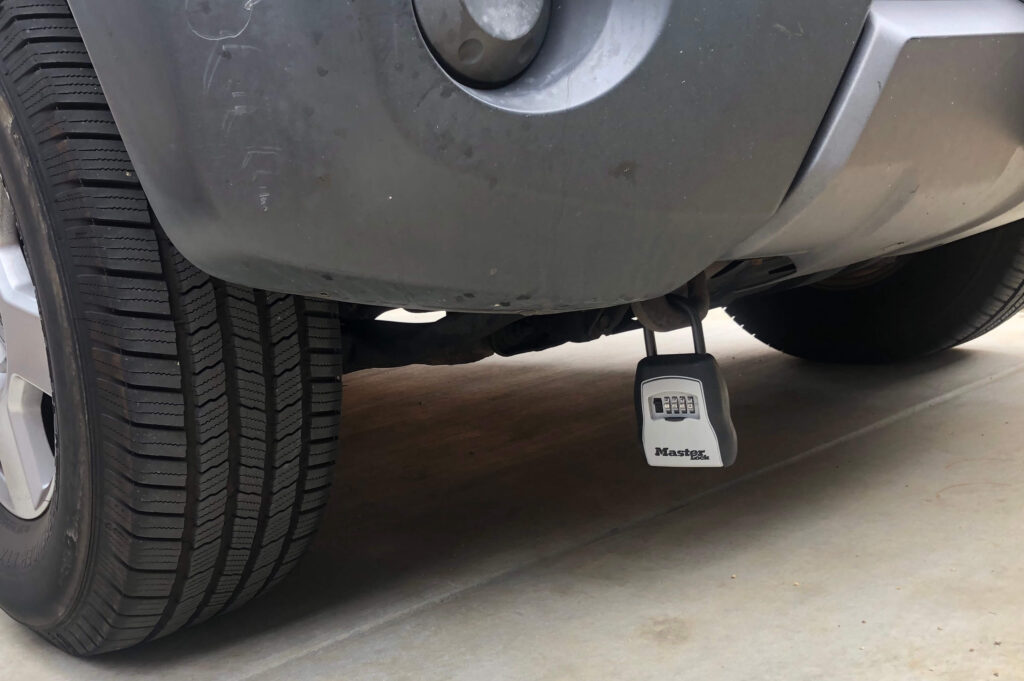
Store keys in here when swimming open water.
A Thermal Neoprene Skull Cap will keep your head warm. The 3 mm coated neoprene keeps your head warm. Your head is first place that will allow heat to escape in cold water. Not sure about you, but I prefer tolerating brain freeze for ice cream only.
Or wear two traditional swim caps. The best way to double cap is to have a latex cap first, then silicon cap second.
Wearing Earplugs
Check out our comprehensive guide to wearing earplugs for swimming. Or skip that and just get Mack’s earplugs; they are the best.
Open water swimming in salt water may cause chaffing. The most common areas are neck and armpits. Try using Trislide for chaffing. This is also a must have for wetsuit users.
Our top overall wetsuit recommendations are Xterra Wetsuits.
A wetsuit will keep you warm and help you float. There are many different options out there. Keep in mind the cut and thickness.
Wetsuits come in full body (ankle to wrist), shortie (knees to elbows), three quarter (ankles to elbows), and farmer john (knees to shoulder).
The thickness is measured in millimeters (mm). The higher the mm, the warmer the wetsuit. If a wetsuit reads 4/3, for example, it is 4 mm in some areas and 3 mm in others. Try 2 – 4 mm depending on the temperature of the water and your preference.
Learn How To Adapt To Cold Water
Pool temperatures can range from 75 – 85 degrees. Open water swimming temperatures can be in the mid-50’s. And depending on the time of the season, the air temperature may not help.
Athlete Approved Tip: When you get into cold open water, remember to exhale! When swimmers tense up in cold water, the natural reaction is to hyperventilate. When this happens, slow down your breathing by exhaling fully.
Side note: swimmers should breathe in through the mouth and out through the nose (opposite of runners).
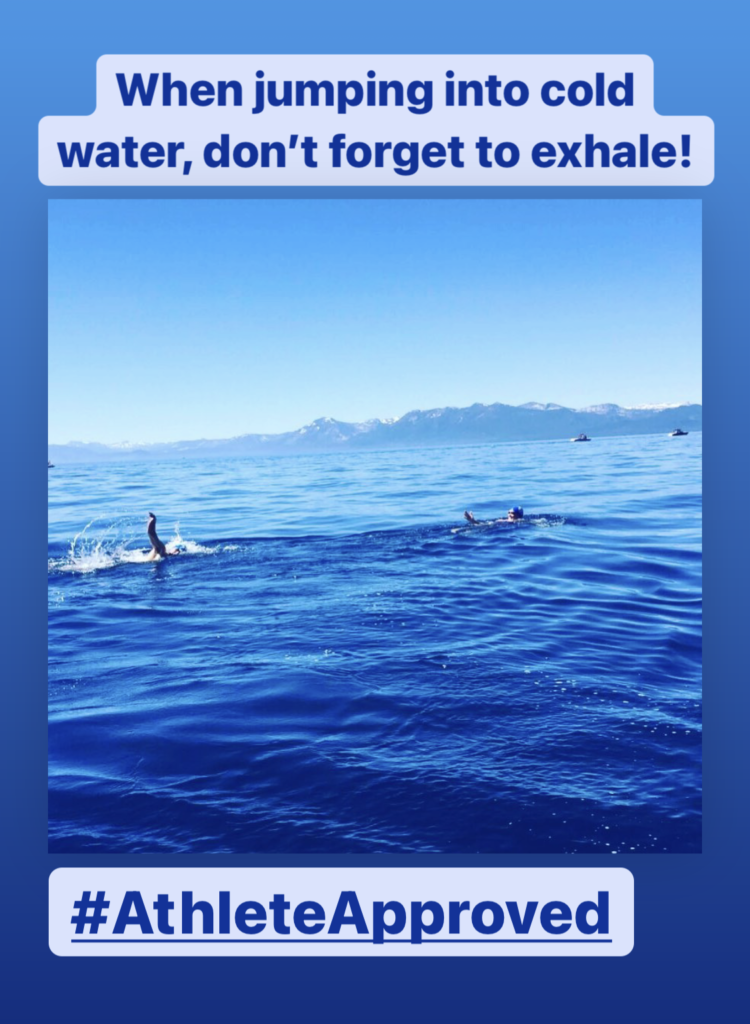
There are three points of adaptation into cold water: waist, shoulders, and head. You can move slowly past each point.
Or sometimes it is best just go for it! Always jump in feet first. You never know how shallow the water may be or what you are jumping into.
Everyone is different, but it will generally take about 4 minutes for your body to adapt to the cold. During that time, remember to breathe, relax, and enjoy the water!
Put Open Water Safety First
Water safety is extremely important in all swimming, especially open water swimming. While a buoy or wetsuit will help you, the two most important things to stay safe are to swim with a buddy and learn how to float.
You should never swim alone. Swimmers need to look out for eachother should someone get into trouble. Despite popular belief, swimming actually is a social sport. A swimming group will encourage accountability. You may also build lifelong bonds with your fellow swimmers.
Alternatives to having a buddy swim with you is for them to follow in a kayak or boat. Or even walk along the shoreline. Although they may not be able to save you, they can at least call for help.
Mastering floating is an important life skill for safety and swimming efficiency. You can use this skill to float on your back and take a break. It also helps you learn how to raise your body position on the water.
- Keep your eyes straight up at the sky for a back float (or down at the bottom for front float).
- Control your breathing. Inflating your lungs will assist in floating.
- Put both hands and feet out like a “starfish” to optimize body position.
You can read our article on how to float in water, or check out to cliff notes above.

Use Tides To Your Advantage
When swimming open water, always keep the tides in mind.
Before swimming, check weather forecasts for high winds and storms which will cause chop. Luckily, these things are predictable.
Each body of water’s tides are unique due to the make up of the geological differences in coastline and seafloor. Wind and weather conditions also play a factor. Talking with locals will get you the inside scoop.
Rip currents are especially dangerous. They occur when water travels from the shore into the ocean. If you are stuck in a rip current, you will be pulled out to the ocean. To escape, swim parallel to the beach until you swim out of it.
If you plan your swim accordingly, you can actually use the tides to your advantage. This will make your swim easier and safer.
Conclusion
Open water swimming is a great way to exercise outdoors. By following our five a tips, you can enjoy the experience of open water swimming with greater safety and more confidence.
Knowing how to sight properly, bringing the right equipment, learning how to adapt to cold water, putting safety first, and using tides to your advantage are the most important things to make swimming open water as enjoyable as possible.
With these five helpful tips under your belt, it’s time for you to make the most out of this amazing open water activity. Remember to have fun, be safe, and enjoy your open water swimming adventure.
*Equip yourself for success with our Athlete Approved Guide to Lap Swimming Equipment!*
1 Comment
Thanks a lot for sharing such a great piece of article! I found it a good helpful write-up with a good sound and explanation. Here I have seen some valuable ideas that are definitely helpful for every swimming enthusiast who wants to swim confidently. Please keep sharing more updates!